
I sit tucked into a 150-person history lecture, with students of International Studies in every direction. To my left, a classmate leans toward me and, gesturing to the large poster board in front of me, asks, “What’s with the sign?” I tell him I had been collecting anecdotes from the multilingual community for a journal piece, trying to dive into words that don’t translate. “I have one,” he offers, “Saudade. It’s Portuguese; it’s kind of like a longing for someone or something, but it’s a little different.” He goes on to explain that saudade is intensely bittersweet. You might long for someone, but you feel it’s a privilege to miss them. You appreciate the longing. When I asked if he felt this influenced the way native Portuguese speakers think about their relationships, he confidently responded, “100%. I think people think about distance not as a barrier, but as a tell-tale sign that they care about someone.”
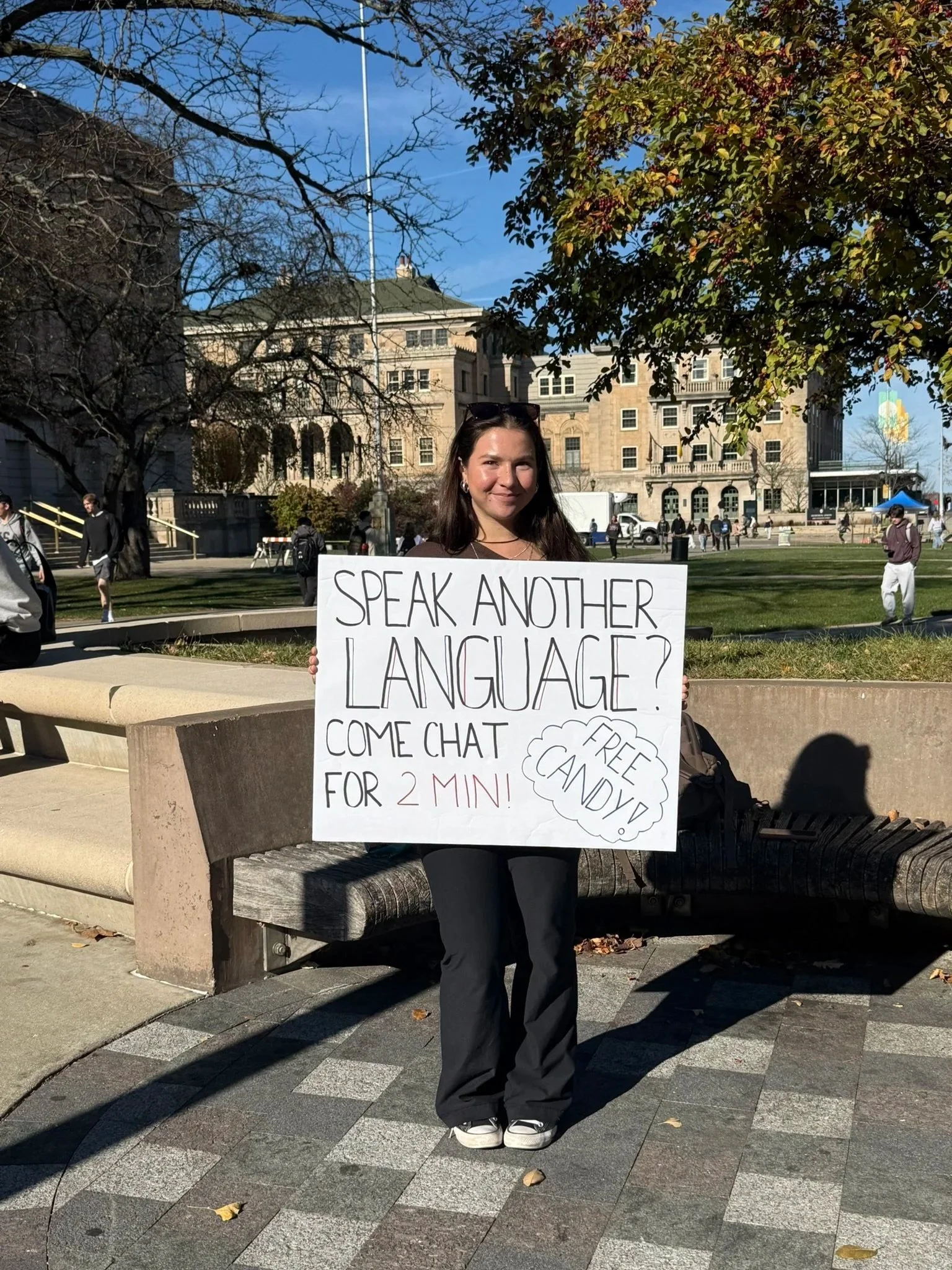
Earlier that sunny November morning, I had positioned myself strategically in Library Mall with my poster board and a bag of fun-sized candy. My offer had been simple: Chat with me about your language for a few minutes, and I’ll let you take a Kit Kat for the road. In an hour, I had almost a dozen takers. I learned words in languages from Albanian to Urdu, and every person who stopped to talk had something to say about the gaps between their language and English. They saw the ways certain words were limited or shaped by their passage between mediums. Below are a few standouts, supplemented by some outside research.
One passerby recalled a time her mother had uttered the Kashmiri curse traṭh peyi tse, an insult to someone who had been mean to her. In English, this phrase translates roughly to “may lightning strike you,” but I learned this translation didn’t carry nearly the weight it did in Kashmiri. “It’s like a soul-shaking insult,” she explained. No English translation could capture its gravity. Hearing this, I began to consider how frustrating it must be to understand a concept, but lack the language to properly convey it to anyone else.
Another mentioned Russian pet names, which lack the human element of “babe” or “baby,” and instead often liken romantic partners to words like “bunny” (zayka) or “sunshine” (solnyshko). While terms of endearment in English frequently compare lovers to sweet foods, those in Russian more commonly refer to baby animals. This begs the question: How do relationships between two individuals speaking Russian and two speaking English differ? Does calling our partners “honey” and not “kotik” (kitten) establish different expectations for a relationship? To what extent do we expect our significant others to uphold the metaphorical terms we use to refer to them?

One man explained that many Turkish expressions actually lacked a concise English translation; the word umursamazlik, for example, roughly translates to “the state of not being able to give a damn.” That said, he also cited the versatility of Turkish’s ya. Ya can mean “no way,” express annoyance, or function in several other unique situations. To a native Turkish speaker, the transition to English demands high energy expenditure. They must decide between English reactions that share a common ya in Turkish; to express umursamazlik requires more than twice as many syllables. As a native English speaker, understanding this compels me to have more empathy for non-native speakers. It also leads me to wonder about where I am “wasting” energy to communicate ideas that other languages have streamlined into a single word. Isolated from alternatives, I probably generate tremendous verbal waste.
These subliminal gaps, between ideas and the ability to articulate them, were perhaps most apparent in one common trend: handling the concept of love. Several explained that the structure of English hindered complexities easily facilitated by their native languages. Turkish, for example, uses three different words for what English calls “the heart,” one metaphorical (yürek), one physical (kalp), and one referring to the heart as a site where love is produced (gönül). It also offers two for “love,” one relaying a broader definition of love (sevgi) and the other referring to passionate, romantic love (aşk). In Hindi, pyaar, ishq, and mohabbat all refer to love, but in different forms, or even different stages. With a more extensive vocabulary available to refer to love, some non-English languages can hegemonize ideas about love itself—how it should be performed, experienced, and categorized. In English, we may take for granted the blurred lines that come as a result of platonic and romantic feelings sharing the same term “love.” Similarly, English does not ask us to transition through versions of the word “love” during the process of falling in it. This creates a cultural understanding of “gliding” through the journey, or depending on how we look at it, strips English speakers of the opportunity to commemorate ascending to different stages of love.
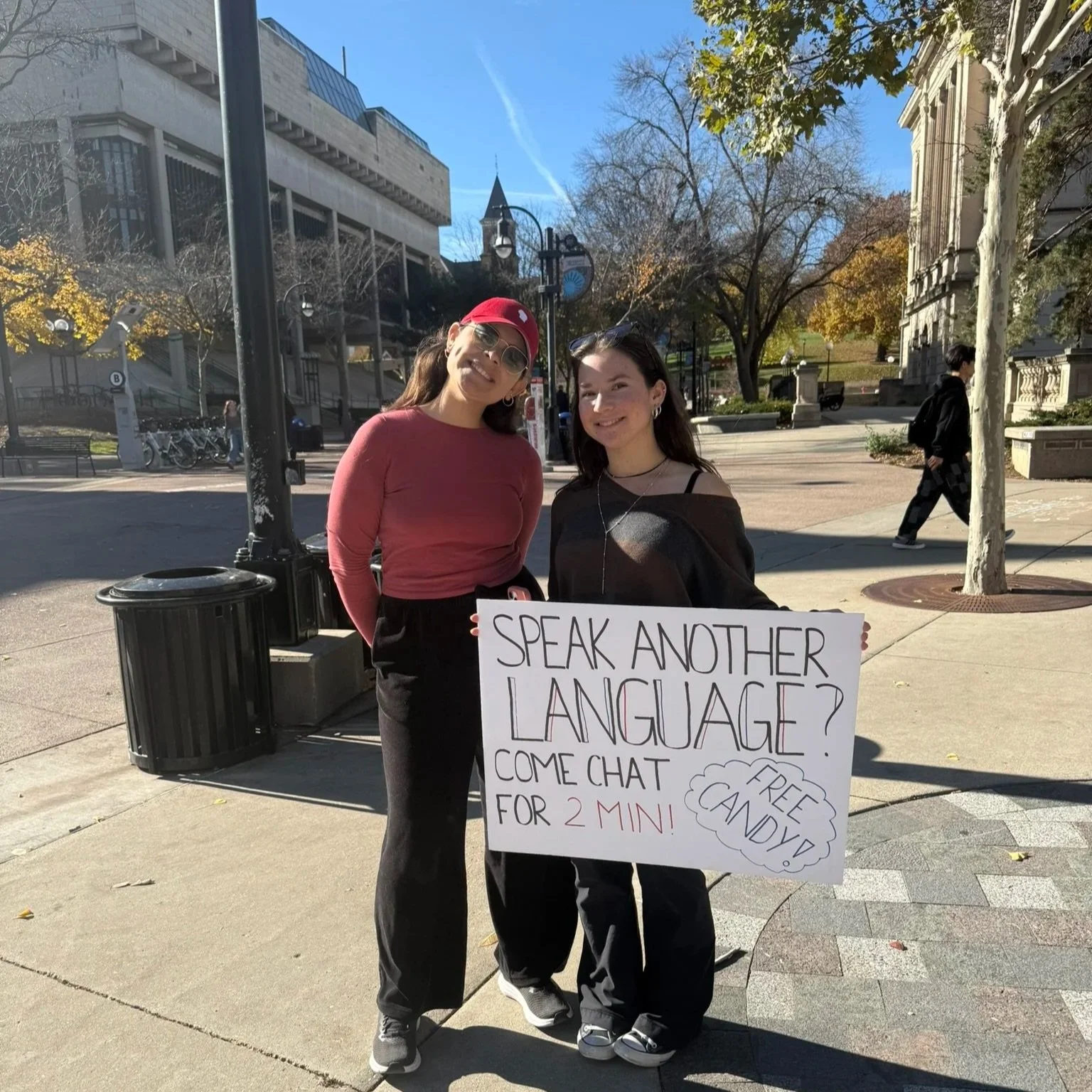
Ultimately, anyone studying language is left to question how well they can really communicate their thoughts and feelings. The people who spoke to me on this warm sidewalk corner lamented losing personality when trying to translate it into English, or struggling to keep up with the unspoken understandings of societal operations written into a language that is not their own. Poetry and creative speech can fall flat in the face of translation—but that seems to make people all the more appreciative of creativity in languages other than English. I heard praise for Arabic and Polish love songs, of the ways they set understandings about passion and affection among their languages’ speakers and conveyed a specific depth of emotion. Really, though, this story goes back to my dad. 25 years ago, on a backpacking trip in South America, his Brazilian friend introduced him to the word saudade, a profound feeling of gratitude for nostalgia. I heard that story at probably 10 years old, but had completely forgotten about it until delving into this project. At the time, I’m not sure I quite grasped the word’s meaning. Honestly, I’m still not sure I do. Yet it inadvertently sparked in me a fascination with the shortcomings of language translation. This thing, which lives in Portuguese but not English, cannot travel through the lips. But the experience is one that is nondiscriminately human. Where we cannot say we must feel. Where we cannot listen, we must live. If we are lucky, our ideas, free of constructed language, will flow between us nonetheless.
All photo credits to Talia Elwyn